
The future is carbon neutral thanks to an AD revolution
Gilles Mayer recently spoke with Farm Contractor magazine to discuss Bennamann’s new EV technology.
A recent Green Gas Britain report by Baringa for the Green Gas Taskforce showed that biomethane can deliver greenhouse gas (GHG) abatement at under £200/t of carbon dioxide by 2050 – making it one of the most cost-effective climate solutions in the UK’s net-zero pathway.
Baringa’s modelling in the report, titled, Green Gas Britain: Reducing the cost of net zero with biomethane, demonstrates that scaling biomethane production from sustainable feedstocks could reduce the cost of reaching net zero by £150bn-£220bn, with savings achieved across transport and power generation, avoiding electricity network investments and decarbonisation of buildings. But realising this potential requires a fundamental infrastructure challenge to be addressed: how to make biomethane production more flexible, efficient and immediately deployable.
Beyond the grid
Traditional anaerobic digestion (AD) plants face a constraint that rarely makes headlines but significantly affects their economics; they depend on grid connections that can take months, and sometimes up to three years, to secure. For local authorities testing electric vehicle (EV) charging locations or construction sites requiring immediate power, this lag represents both a commercial barrier and a missed decarbonisation opportunity.
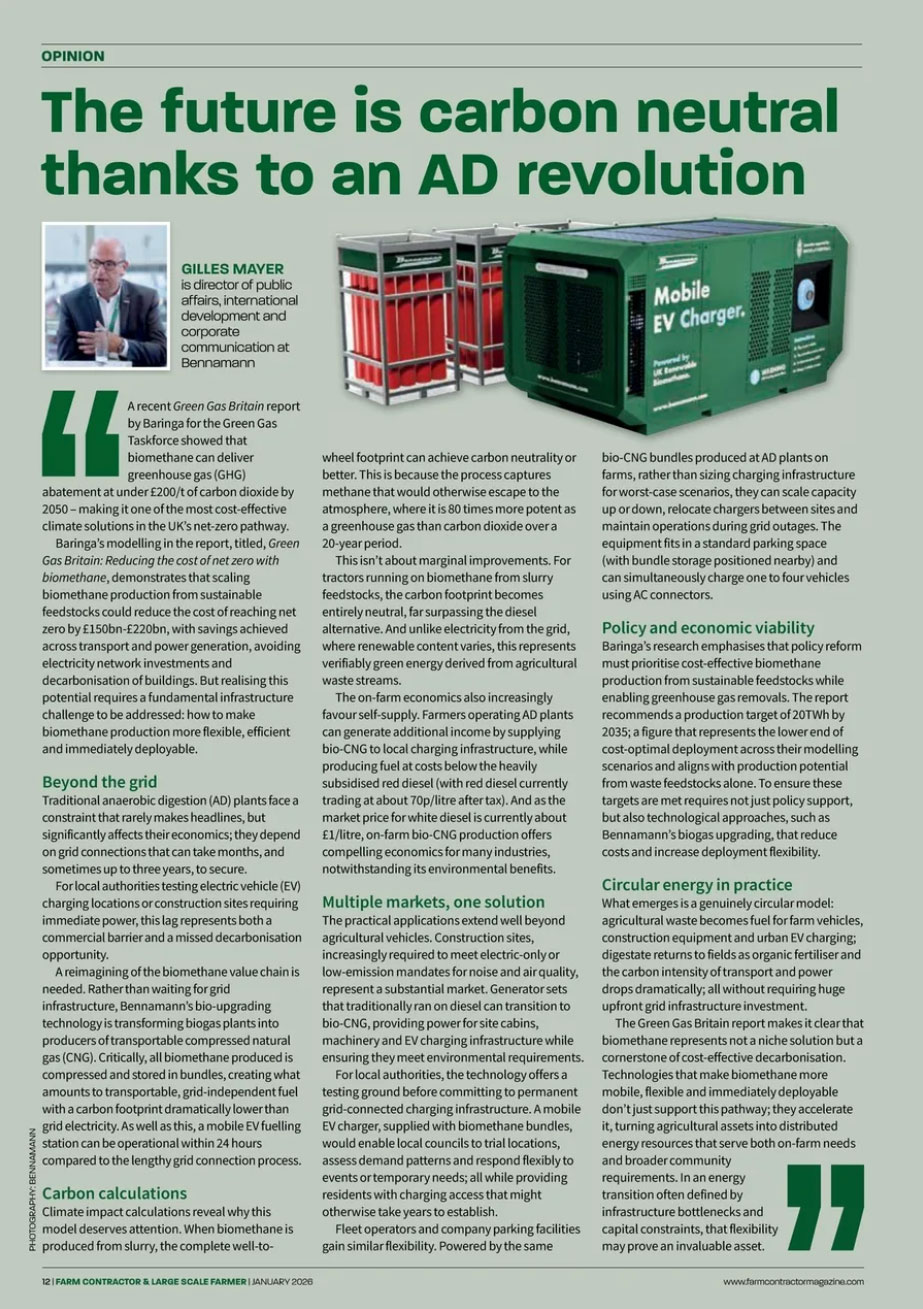
A reimagining of the biomethane value chain is needed. Ratherthan waiting for grid infrastructure, Bennamann’s bio-upgrading technology is transforming biogas plants into producers of transportable compressed natural gas (CNG). Critically, all biomethane produced is compressed and stored in bundles, creating what amounts to transportable, grid-independent fuel with a carbon footprint dramatically lower than grid electricity. As well as this, a mobile EV fuelling station can be operational within 24 hours compared to the lengthy grid connection process.
Carbon calculations
Climate impact calculations reveal why this model deserves attention. When biomethane is produced from slurry, the complete well-to-wheel footprint can achieve carbon neutrality or better. This is because the process captures methane that would otherwise escape to the atmosphere, where it is 80 times more potent as a greenhouse gas than carbon dioxide over a 20-year period.
This isn’t about marginal improvements. For tractors running on biomethane from slurry feedstocks, the carbon footprint becomes entirely neutral, far surpassing the diesel alterative. And unlike electricity from the grid, where renewable content varies, this represents verifiably green energy derived from agricultural waste streams.
The on-farm economics also increasingly favour self-supply. Farmers operating AD plants can generate additional income by supplying bio-CNG to local charging infrastructure, while producing fuel at costs below the heavily subsidised red diesel (with red diesel currently trading at about 70p/litre after tax). And as the market price for white diesel is currently about £1/litre, on-farm bio-CNG production offers compelling economics for many industries, notwithstanding its environmental benefits.
Click the image to view the article online.
Multiple markets, one solution
The practical applications extend well beyond agricultural vehicles. Construction sites, increasingly required to meet electric-only or low-emission mandates for noise and air quality, represent a substantial market. Generator sets that traditionally ran on diesel can transition to bio-CNG, providing power for site cabins, machinery and EV charging infrastructure while ensuring they meet environmental requirements.
For local authorities, the technology offers a testing ground before committing to permanent grid-connected charging infrastructure. A mobile EV charger, supplied with biomethane bundles, would enable local councils to trial locations, assess demand patterns and respond flexibly to events or temporary needs; all while providing residents with charging access that might otherwise take years to establish.
Fleet operators and company parking facilities gain similar flexibility. Powered by the same bio-CNG bundles produced at AD plants on farms, rather than sizing charging infrastructure for worst-case scenarios, they can scale capacity up or down, relocate chargers between sites and maintain operations during grid outages. The equipment fits in a standard parking space (with bundle storage positioned nearby) and can simultaneously charge one to four vehicles using AC connectors.
Policy and economic viability
Baringa’s research emphasises that policy reform must prioritise cost-effective biomethane production from sustainable feedstocks while enabling greenhouse gas removals. The report recommends a production target of 20TWh by 2035; a figure that represents the lower end of cost-optimal deployment across their modelling scenarios and aligns with production potential from waste feedstocks alone. To ensure these targets are met requires not just policy support, but also technological approaches, such as Bennamann’s biogas upgrading, that reduce costs and increase deployment flexibility.
Circular energy in practice
What emerges is a genuinely circular model: agricultural waste becomes fuel for farm vehicles, construction equipment and urban EV charging; digestate returns to fields as organic fertiliser and the carbon intensity of transport and power drops dramatically; all without requiring huge upfront grid infrastructure investment.
The Green Gas Britain report makes it clear that biomethane represents not a niche solution but a cornerstone of cost-effective decarbonisation.
Technologies that make biomethane more mobile, flexible and immediately deployable don’t just support this pathway; they accelerate it, turning agricultural assets into distributed energy resources that serve both on-farm needs and broader community requirements. In an energy transition often defined by infrastructure bottlenecks and capital constraints, that flexibility may prove an invaluable asset.

